The Awful Privilege

“The great intercessor must possess an extreme sensitiveness to the state and needs of souls and of the world. As those who live very close to nature become tuned to her rhythm, and can discern in solitary moments all the movements of her secret life, or as musicians distinguish each separate note in a great symphony and yet receive the music as a whole; so the intercessor, whether living in the world or enclosed in a convent (for these are only differences in technique) is sensitized to every note and cadence in the rich and intricate music of common life. He stretches out over an ever wider area the filaments of love, and receives and endures in his own person the anguish of its sorrow, its helplessness, its confusions, and its sin; suffering again and again the darkness of Gethsemane and the cross, as the price of his redemptive power. For it is his awful privilege to stand in the gap between the world’s infinite need and the treasuries of the Divine Love.”

Evelyn Underhill

The Snake on the Stick

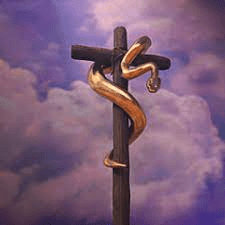
Hippocrates, the father of Western medicine, was a devotee of Asclepius, the Greek god of healing. His symbol was a snake on a stick, known as the Rod of Asclepius.

The Hebrew Nehushtan is a bronze image of a serpent on a pole. Moses prayed to God, who told Moses, “Make thee a fiery serpent, and set it upon a pole; and it shall come to pass, that every one that is bitten, when he seeth it, shall live.” (Numbers 21: 4-9)

This story is taken up in the New Testament, where Jesus identifies himself with the fiery serpent, saying, “And as Moses lifted up the serpent in the wilderness, even so must the Son of man be lifted up:
That whosoever believeth in him should not perish, but have eternal life.” (John 3: 14-15)

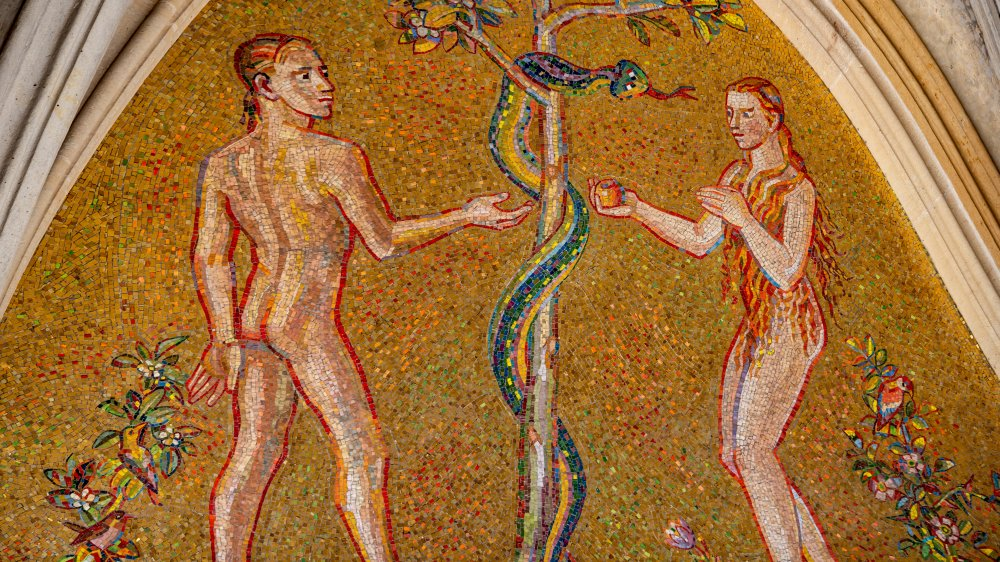
The image of a snake on a stick is dramatically realized in paintings and illustrations of the snake tempting Adam and Eve in the garden of Eden, coiled around the trunk of the tree of the knowledge of good and evil.

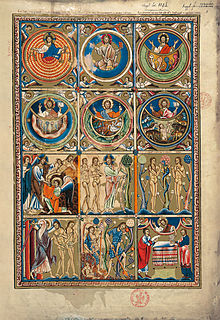
Plate 13 of the Great Canterbury Psalter, which dates from around 1200 AD, intriguingly depicts the tree as a giant mushroom (ninth panel).

So what does it all mean? Some snakes are extremely dangerous. Their venom is so strong it can kill an adult human with a single bite. The Australian Taipan is the world’s deadliest snake, but many other species, such as King Cobras, Black Mambas, Death Adders, Pit Vipers, Rattlesnakes and Tiger Snakes are also lethal. (The snake that ravaged the Israelites in the wilderness may well have been the Egyptian Cobra).

Some mushrooms are also poisonous enough to kill you, such as the Death Cap, the three Destroying Angels and the Fool’s Mushroom. There are others which are highly toxic but non lethal, such as the Amanita Muscaria, which have psychoactive properties.

One man’s poison is another man’s medicine. The Greek word pharmakon means both cure and poison. We can see this paradoxical connection both in conventional Western medicine, as in the development of vaccines, as well as in Mithridatism, Traditional Chinese Medicine and alternative medicines like homeopathy.

The snake on the stick image can be seen to symbolize the taming of poison and the production of medicine, hence its ubiquitous use in medical organisations around the world. This can be taken in a literal, material, molecular, chemical sense, with the development of new medicines in the lab, but it can also be taken in an esoteric, spiritual sense, in the controlled use of psychedelics in the astrolab of the soul.

A wild snake in the wilderness can kill you. A tame snake on a stick can heal you. If you can lift the fiery serpent kundalini up the energetic pole of the sushumna nadi along the central nervous system, who knows, you may even “have eternal life”.

The Four States

In the beginning was the Word.

This was the first creation,

The primordial vibration,

the first Logos,

AUM.

From this primordial womb of sound,

From the undifferentiated,

Infinite source,

Other vibrations emerged,

Seed syllables,

Numerous as the sands of the Ganges.

This was the second creation,

The second Logos, Akasha,

The archetypal forms,

Constituting the heavens and all therein.

From the Akashic archetypes

Emerged the third Logos,

The third creation,

The coincidence of opposites,

Yin-Yang,

Shiva-Shakti,

And the manifest universe was born.

The One, Parashiva,

Descending through the Logoi,

The primordial AUM and the heavenly Akasha,

Became contingent Shiva

Eternally dancing as Nataraja

With his other half, Shakti.

Where there is Shakti, there is Shiva;

Where there is Shiva, there is Shakti.

Relative consciousness must have its objects

And objects must be apprehended.

There is no Shakti without Shiva.

Shiva draws Shakti from Akasha

By collapsing potential into actuality

With the light of consciousness,

Creating quantum fluctuations

In the Akashic Void.

And so the manifest universe evolves,

Through pattern recognition

And relevance realization,

Into higher order complex structures

Of consciousness and form,

Until a critical pitch of intensity is reached

in certain bipedal organisms

Who remember:

In the beginning was the Word,

and the Word was with God,

and the Word was God.

Before the beginning,

Before the first creation,

Before the first Logos,

Parashiva,

One without a second,

Infinite consciousness

Eternally conscious of itself,

Produced Unity,

The first state,

Deep Sleep.

The first Word, AUM,

And the second Word, the Akashic Logoi,

Made heaven,

A Dream,

The second state.

“Tao produced Unity; Unity produced Duality; Duality produced Trinity”:

But the earth was without form, and void;

And darkness was upon the face of the deep.

And the Spirit of God moved upon the face of the waters.

And Shakti danced into being,

And there was a dancing universe, Shakti,

Experienced by a dancing Witness, Shiva.

“Tao produced Unity; Unity produced Duality; Duality produced Trinity;

And Trinity produced all existing objects.” –

Parashiva, Shiva, Shakti;

Tao, Yin, Yang –

A Waking tetrahedron universe,

The third state.

Over countless aeons,

Relative consciousness and form, Shiva-Shakti,

Finally discovers its source in Parashiva,

The eternal Father,

And the people walking in darkness saw a great light,

The true Light, which lighteth every man that cometh into the world.

This is Turiya,

The fourth state,

Enlightened Buddha Nature,

Christ Consciousness,

The Son of the Father,

Who brings forth a new heaven and a new earth,

A new creation,

A new Logos,

Preached until the end of time

In the gospel of the kingdom of God.

Lost in Babylon

I decided to limit the reading list to only that handful of books which I consider essential reading for a true understanding of the practice of psychedelic Christianity. Without an idea of the holy, the courage to be, experience of God and the love of God, we are lost indeed.

How God Works

Beyond the horizon of the phenomenal world, beyond the horizon of your phenomenal world, is pure consciousness, one without a second. This pure consciousness is that which sustains your world, that which holds it in existence. Otherwise, an experienced world would be impossible.

On the other side of the dividing line between phenomena and noumena is pure, absolute consciousness, Parashiva. On this side of the line is subjective consciousness and its objective world, Shiva and Shakti.

Parashiva by definition cannot be in direct relation to the world, because as soon as there is an experienced world and an experiencer of the world, phenomena and consciousness, we are in the realm of subject and object, Shiva and Shakti, no longer the nondual “one without a second”.

Is the background consciousness of our worlds an inert world-enabler, a kind of cosmic microwave background? Is “God” basically irrelevant to the actual functioning of the world? The Original Cause merely, an Unmoved Mover who retired for good on the seventh day of Creation as Deists thought?

If God as absolute consciousness were to have any influence on the physical, contingent world of things and history, it would have to be through the medium of relative consciousness, Shiva, since Shiva shares the essential nature of Parashiva (consciousness), but in relationship with the phenomenal world, Shakti.

This is why it is said that the Son is both fully God and fully man. If it were otherwise, there would be no point of contact. Redemption, which really means “being put right with God”, is impossible without contact, without a bridge between God and the world.

This bridge is Christ, the Anointed One. The anointing consists of complete absorption of Shiva in Parashiva, of the Son in the Father. The transforming power of this immersion, this baptism in the waters of pure consciousness, is manifest on return to the world, now revealed as a pure land, or “kingdom of God”, filled with the glory of the Holy Spirit. Shakti removes Her veil in a revealing apokalypsis.

Thus, through the agency of conscious human beings, God patiently works His magic on the world, one soul at a time.

John 17

These words spake Jesus, and lifted up his eyes to heaven, and said, Father, the hour is come; glorify thy Son, that thy Son also may glorify thee:

As thou hast given him power over all flesh, that he should give eternal life to as many as thou hast given him.

And this is life eternal, that they might know thee the only true God, and Jesus Christ, whom thou hast sent.

I have glorified thee on the earth: I have finished the work which thou gavest me to do.

And now, O Father, glorify thou me with thine own self with the glory which I had with thee before the world was.

I have manifested thy name unto the men which thou gavest me out of the world: thine they were, and thou gavest them me; and they have kept thy word.

Now they have known that all things whatsoever thou hast given me are of thee.

For I have given unto them the words which thou gavest me; and they have received them, and have known surely that I came out from thee, and they have believed that thou didst send me.

I pray for them: I pray not for the world, but for them which thou hast given me; for they are thine.

10 And all mine are thine, and thine are mine; and I am glorified in them.

11 And now I am no more in the world, but these are in the world, and I come to thee. Holy Father, keep through thine own name those whom thou hast given me, that they may be one, as we are.

12 While I was with them in the world, I kept them in thy name: those that thou gavest me I have kept, and none of them is lost, but the son of perdition; that the scripture might be fulfilled.

13 And now come I to thee; and these things I speak in the world, that they might have my joy fulfilled in themselves.

14 I have given them thy word; and the world hath hated them, because they are not of the world, even as I am not of the world.

15 I pray not that thou shouldest take them out of the world, but that thou shouldest keep them from the evil.

16 They are not of the world, even as I am not of the world.

17 Sanctify them through thy truth: thy word is truth.

18 As thou hast sent me into the world, even so have I also sent them into the world.

19 And for their sakes I sanctify myself, that they also might be sanctified through the truth.

20 Neither pray I for these alone, but for them also which shall believe on me through their word;

21 That they all may be one; as thou, Father, art in me, and I in thee, that they also may be one in us: that the world may believe that thou hast sent me.

22 And the glory which thou gavest me I have given them; that they may be one, even as we are one:

23 I in them, and thou in me, that they may be made perfect in one; and that the world may know that thou hast sent me, and hast loved them, as thou hast loved me.

24 Father, I will that they also, whom thou hast given me, be with me where I am; that they may behold my glory, which thou hast given me: for thou lovedst me before the foundation of the world.

25 O righteous Father, the world hath not known thee: but I have known thee, and these have known that thou hast sent me.

26 And I have declared unto them thy name, and will declare it: that the love wherewith thou hast loved me may be in them, and I in them.

The Gospel according to John, chapter 17.

Romans 8

There is therefore now no condemnation to them which are in Christ Jesus, who walk not after the flesh, but after the Spirit.

For the law of the Spirit of life in Christ Jesus hath made me free from the law of sin and death.

For what the law could not do, in that it was weak through the flesh, God sending his own Son in the likeness of sinful flesh, and for sin, condemned sin in the flesh:

That the righteousness of the law might be fulfilled in us, who walk not after the flesh, but after the Spirit.

For they that are after the flesh do mind the things of the flesh; but they that are after the Spirit the things of the Spirit.

For to be carnally minded is death; but to be spiritually minded is life and peace.

Because the carnal mind is enmity against God: for it is not subject to the law of God, neither indeed can be.

So then they that are in the flesh cannot please God.

But ye are not in the flesh, but in the Spirit, if so be that the Spirit of God dwell in you. Now if any man have not the Spirit of Christ, he is none of his.

10 And if Christ be in you, the body is dead because of sin; but the Spirit is life because of righteousness.

11 But if the Spirit of him that raised up Jesus from the dead dwell in you, he that raised up Christ from the dead shall also quicken your mortal bodies by his Spirit that dwelleth in you.

12 Therefore, brethren, we are debtors, not to the flesh, to live after the flesh.

13 For if ye live after the flesh, ye shall die: but if ye through the Spirit do mortify the deeds of the body, ye shall live.

14 For as many as are led by the Spirit of God, they are the sons of God.

15 For ye have not received the spirit of bondage again to fear; but ye have received the Spirit of adoption, whereby we cry, Abba, Father.

16 The Spirit itself beareth witness with our spirit, that we are the children of God:

17 And if children, then heirs; heirs of God, and joint-heirs with Christ; if so be that we suffer with him, that we may be also glorified together.

18 For I reckon that the sufferings of this present time are not worthy to be compared with the glory which shall be revealed in us.

19 For the earnest expectation of the creature waiteth for the manifestation of the sons of God.

20 For the creature was made subject to vanity, not willingly, but by reason of him who hath subjected the same in hope,

21 Because the creature itself also shall be delivered from the bondage of corruption into the glorious liberty of the children of God.

22 For we know that the whole creation groaneth and travaileth in pain together until now.

23 And not only they, but ourselves also, which have the firstfruits of the Spirit, even we ourselves groan within ourselves, waiting for the adoption, to wit, the redemption of our body.

24 For we are saved by hope: but hope that is seen is not hope: for what a man seeth, why doth he yet hope for?

25 But if we hope for that we see not, then do we with patience wait for it.

26 Likewise the Spirit also helpeth our infirmities: for we know not what we should pray for as we ought: but the Spirit itself maketh intercession for us with groanings which cannot be uttered.

27 And he that searcheth the hearts knoweth what is the mind of the Spirit, because he maketh intercession for the saints according to the will of God.

28 And we know that all things work together for good to them that love God, to them who are the called according to his purpose.

29 For whom he did foreknow, he also did predestinate to be conformed to the image of his Son, that he might be the firstborn among many brethren.

30 Moreover whom he did predestinate, them he also called: and whom he called, them he also justified: and whom he justified, them he also glorified.

31 What shall we then say to these things? If God be for us, who can be against us?

32 He that spared not his own Son, but delivered him up for us all, how shall he not with him also freely give us all things?

33 Who shall lay any thing to the charge of God’s elect? It is God that justifieth.

34 Who is he that condemneth? It is Christ that died, yea rather, that is risen again, who is even at the right hand of God, who also maketh intercession for us.

35 Who shall separate us from the love of Christ? shall tribulation, or distress, or persecution, or famine, or nakedness, or peril, or sword?

36 As it is written, For thy sake we are killed all the day long; we are accounted as sheep for the slaughter.

37 Nay, in all these things we are more than conquerors through him that loved us.

38 For I am persuaded, that neither death, nor life, nor angels, nor principalities, nor powers, nor things present, nor things to come,

39 Nor height, nor depth, nor any other creature, shall be able to separate us from the love of God, which is in Christ Jesus our Lord.

Paul’s letter to the Romans, chapter 8.

The Consummation of Worship

“The Christian hope of the future is that … the true message and meaning of the Incarnation will come to be more deeply understood: and the demand on man’s worshipping love and total self-offering, will receive a more complete response – a response stretching upward in awe-struck contemplation to share that adoring vision of the Principle which is ‘the inheritance of the saints of light,’ and downwards and outwards in loving action, to embrace and so transform the whole world. When this happens, Christian sacramental worship will at last disclose its full meaning and enter into its full heritage. For it will be recognized as the ritual sign of our deepest relation with Reality, and so of the mysterious splendour of our situation and our call: the successive life of man freely offered in oblation, and the abiding life of God in Christ received, not for our own sakes, but in order to achieve that transfiguration of the whole created universe, that shining forth of the splendour of the Holy, in which the aim of worship shall be fulfilled.”

Evelyn Underhill

Bombu Nature and Absolute Faith

According to Shin Buddhism, we humans have the capacity for Buddha Nature, but typically express Bombu Nature. The usual translation for Bombu is “a foolish being of wayward passion”. Human beings, in their unregenerate state, are foolish beings of wayward passion.

What is “wayward passion”? Anger, hatred, jealousy, fear, lust, greed. In the Wheel of Babylon, derived from the Tibetan Wheel of Life, these emotional states are personified in three archetypal figures, namely, the Demon, the Victim and the Addict.

What is “foolish being”? Willful ignorance, self-righteous delusion and conceited arrogance. These states are personified in the upper three archetypes of the Wheel of Babylon, that is, the Muggle, the Muppet and the Diva.

According to Shin Buddhism, the only way to overcome our ingrained Bombu Nature is by throwing ourselves on the mercy of the Cosmic Buddha, Amida Butsu, since nothing within the closed system of the Wheel of Life can liberate us from it. We cannot pull ourselves up by our bootstraps. Thus Shin is known as the Buddhism of Faith.

The Way of the Holy Mushroom is also a Way of Faith, and for exactly the same reason, which is simply that There Is No Other Way. Either you give up tying yourself up in knots with the endless twists and turns of the ego, or you don’t. Either you “die before you die” (which is to say, die to your self), or you don’t. Either you have faith and surrender to life unmediated by foolishness and wayward passion, or you don’t.

Paul Tillich writes of the need for the existential courage to despair and the need for absolute faith in the face of meaninglessness beyond the dishonest but comforting half-measures and cop-outs of the ego. The courage to be holy is the courage to despair of Babylon and put all your trust in the power of Being-itself. Whether you call it “the love of Amida” or “the love of God” doesn’t really matter. Just have faith, absolute faith.

“Love breaks down the barrier that shuts most of us from Heaven. That thought is too much for us really, yet it is the central truth of the spiritual life. And that loving, self-yielding to the Eternal Love – that willingness that God shall possess, indwell, fertilize, bring forth the fruit of His Spirit in us, instead of the fruits of our spirit – is the secret of all Christian power and Christian peace.”

Evelyn Underhill