Between the One and the Many

The problem of the One and the Many is a perennial philosophical problem reaching back into the mists of antiquity, in Greece first encountered in the writings of the Pre-Socratics Thales, Parmenides, Heraclitus, Democritus, Pythagoras and co.

This is not just a question for speculative philosophy, however. It is an existential question that can confront us in the heights and depths of psychedelic mystical experience. We can actually experience the One as a nondual unity encompassing all of Reality, ourselves included. This is often alluded to as “ego death” because all the usual categories of self and other dissolve. We can also experience the Many as a dizzyingly infinite multiplicity of beings and things numberless as the sands of the seashore or the stars in the sky.

In print, in the comfort of your own human mind, this sounds fine, even desirable. Who would turn down the chance to experience the One and the Many first hand? Well, be careful what you wish for. Allen Ginberg hauntingly wrote, “I saw the best minds of my generation destroyed by madness”, and I wager that not a few of those will have been driven mad by a precipitous fall into the One or the Many.

The human mind cannot fathom the One or the Many. The One is unnameable, as Jewish tradition has it, just as the Tao is unnameable according to the Chinese, because in the One everything dissolves. There can be no name, no namer and no named. We can point to it with a sign, JHWH, Tao, God, in order to talk about it, but these are just pointers. In the experience of the One, even the idea of Oneness dissolves. Likewise, the Many is impossible to grasp. Although we can have a coherent idea of the meaning of the word “infinite”, for example, our minds cannot grasp even very large numbers, such as the number of stars in our galaxy, or the number of galaxies in the universe.

We can have glimpses of the One and the Many in deep psychedelic meditation. They are awe-inspiring and occasionally terrifying. Sometimes fleeting, sometimes never-ending (seemingly), these strange experiences feel like they complete us in some mysterious metaphysical way. However, as I indicated above, they are also potentially dangerous, if you’re not ready.

So what does readiness entail? How can you prepare for the eventuality of a seismic breakthrough to the limit of ultimate Reality itself?

In order to answer this question in a way comprehensible to the human mind, I will approach it pictorially. Imagine a long ruler or x axis numbered between 0 and 10,000. The number 0 represents the One (even the One disappears in the One) and the number 10,000 represent the Many (as Taoist convention has it).

Now imagine that the number 10 represents conventional human reality. Everything is experienced and understood within the defining structures of base 10 (so to speak). People in this position may have a theoretical notion of the One and the Many, but they cannot actually experience them. They may believe in God, for example, but it will be, at best, a conventional, dualistic, base 10 God, and at worst, a psychological projection.

10 is relatively close to ground 0 so people at 10 are kept in orbit around the massive black hole of the One and don’t fly off into the infinite void of outer space. It’s as though they lived on Mercury, orbiting tightly around the sun. Staying with the solar system metaphor, Venus would then represent 11 and Earth 12. Imagine further that Venus (think angel number 1111) is an unstable magical place, elusive and ephemeral. People can’t stay there very long, and quickly find themselves back on Mercury or on Earth.

Now imagine that Earth’s orbit represents a limit beyond which the distance from the sun stretches too far. Mars represents the next number 13, unlucky for some. Mars is habitable, but not hospitable. For a start, it’s too cold. Beyond Mars is the chaotic asteroid belt and the gas planets.

In our analogy, people on Mercury (10) are safe, but narrow. People on Mars (13) have a more expanded consciousness, but are on a risky trajectory. Inherently unstable, they are prone to expand uncontrollably outwards into cosmic infinity. Too far from the unifying gravity of the One, they are in danger of fragmentation and madness. I suppose Ginsberg’s unfortunate friends were probably mostly Martians.

People on Earth (people of the 12 tribes) are in a comfortable Goldilocks position. However, they can easily slip onto the 10 or 13 position and get either stuck or lost. We need something extra to keep us in place. G.I. Gurdjieff called this something extra “the Law of Three” and “the Law of Seven”. I won’t go into the intricacies of all this now, but for the purposes of this imaginative exercise, simply picture lines connecting 3, 7 and 12 on the axis.

10 is rigid and predictable and 13 is irregular and unstable. People on 10 and 13 orbit the One but are not intimately connected to it and so cannot safely navigate the Many. But people on 12 who are connected to the nondual 1 via 7 and 3, are protected from disintegration and dispersal in the 10,000 things.

In the psychedelic context, to “turn on” is to have a vision, perhaps even a beatific vision, of the 1, the 3, the 7, or all three at once. It is a kind of kensho, a waking up to the true nature of metaphysical reality. Once you have seen it, you know you have seen it, and you cannot unsee it. You have achieved gnosis. You have turned on the spiritual faculty, or opened the third eye.

If this mystical experience is to have any lasting effect on the personality, however, it must be integrated through a process of consolidation. You now need to “tune in”. This is done primarily through contact, regular and sincere, with the riches of your spiritual tradition. In so doing, you awaken and strengthen faith, pistis. This process is both linear and cyclical and typically follows a 12 month cycle (for a Christian option see the Meditation page).

Once you have sufficiently tuned in and have achieved “great faith” (Rinzai) or “absolute faith” (Tillich), you are ready to “drop out”. This does not mean you become a dharma bum, as many Timothy Leary fans did in the 1960’s and 1970’s. It means you leave the world of dualistic human left-brain thinking behind, through self-emptying kenosis, and begin to live in the nondual world of headless immediacy. This is called “being born in the Pure Land” or “entering the Kingdom of God”. It is living out 1, 3, 7, 12 in the 10,000 things.

With this understanding, Leary’s hippy slogan, “turn on, tune in, drop out” is not a recipe for selfishness and irresponsibility. It points to the same liberation that Christ and Buddha point to. In Buddhist terms, it is “escape from Samsara”. In Christian terms, it is both “escape from Babylon” and “escape from Zion”. Salvation through Christ is salvation from the religious bondage of Mercury (10) and the worldly bondage of Mars (13) through connection with the One and the Many.

Jesus said to his disciples, “be of good cheer; I have overcome the world” (John 16:33). In his final discourse he said to them, “ye are not of the world, but I have chosen you out of the world” (John 15:19). When questioned by Pilate, he declared, “my kingdom is not of this world” (John 18:36).

Key:

10 = religious but not spiritual (Mercury 10) = “bound”

11 = magical (Venus 11) = “unhinged”

12 = spiritual and religious (Earth 12) = “contained”

13 = spiritual but not religious (Mars 13) = “unmoored”

1 + 3 + 7 = mystical (Sun 11) = “detached”

11 + 12 = magical, spiritual and religious (Venus and Earth 23) = “fantastical”

1 + 3 + 7 + 12 = spiritual, religious and mystical (Sun and Earth 23) = “incarnation

11 + 13 = magical and spiritual but not religious (Venus and Mars 24) = “space cadet”
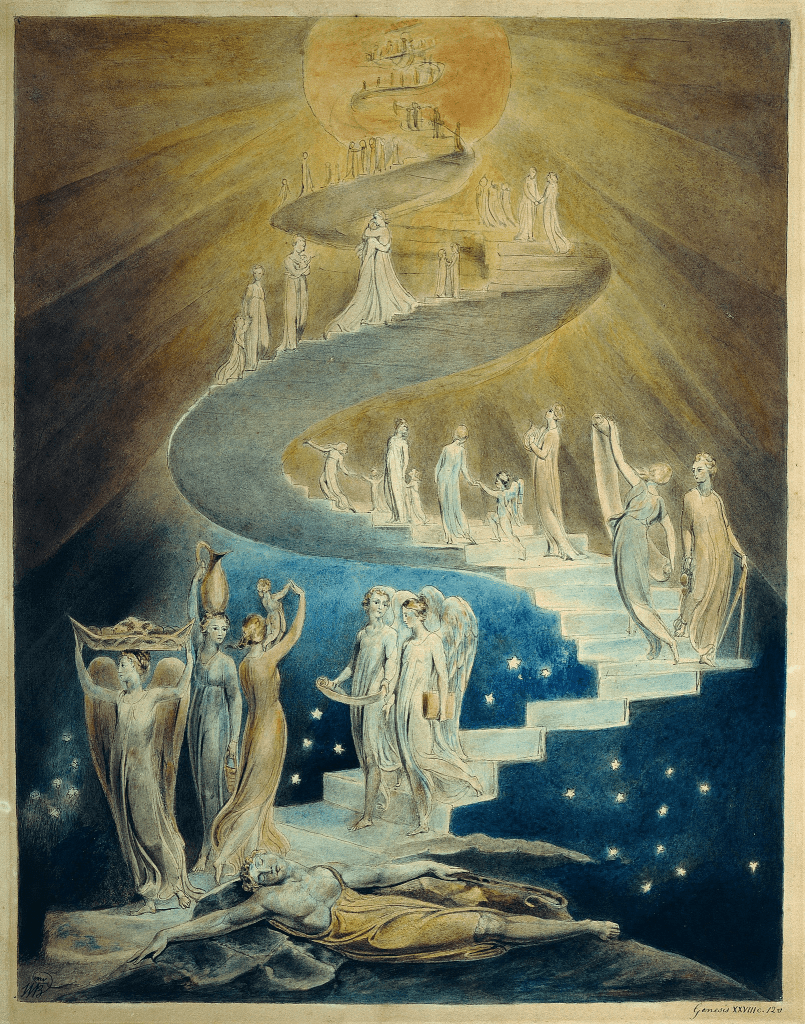
Blake’s Spiral

o

MV: “Blake’s famous image of Jacob’s ladder, with Jacob asleep on the ground and then the staircase with the figures ascending and descending, reaching into the heavens, you make the point that Blake’s the only person to draw this as a spiral…”

IMcG: “The reason that I think that the spiral is so important is that it is the only shape that brings two things together, the fact of an open ended process and the idea of contraries. Blake said “without contraries there is no progression” … it’s that idea that I see in Heraclitus, of the tautness of a bowstring or the tautness of a lyre string, and without the tautness of pulling in opposite directions there is no power to produce a note or power to let fly the arrow. Sometimes you get this idea that things are circular – T.S. Eliot gives famous expression to the idea that we come back to the place we started from and know it for the first time – but what I think is a better idea is that we go round on a spiral and we don’t come back to where we started from, we are higher up than we were, but we come back to the place that is over the other place and now we can see what it was and what we thought then. So we are making progress…”

MV: “…anamnesis, to return to something and make it present once more … is what a ritual does. The ritual repeats at one level but it repeats constantly to draw back the Source. The manner in which we inhabit our memories is really important, and that’s often a ritual, embodied practice, in order that memory and inspiration can then come together. The memory becomes re-inspiring – it breathes something fresh into us.”

IMcG: “We need something like that actually, which is structured enough to summon whatever it is, but also loose enough to allow it to live, not to pin down and utterly specify. That’s why a ritual has to remain implicit, and once it’s made explicit, a lot of that is lost. I find it interesting that at a time of great upsurge in left hemisphere thinking, which I associate with the Reformation, there was a lot of technical dispute about what was meant by a very important ritual of the body and blood of Christ.”

Transcript from a conversation between Mark Vernon and Iain McGilchrist on William Blake: Imagination and Inspiration, Science and Soul (posted on YouTube on 1st July 2025).

What do you Believe?

  1. There is no Divinity, only human fantasy and delusion.
  2. There is Divinity, but no possibility of meaningful human contact with it.
  3. Human intercourse with Divinity is clearly delimited and circumscribed.
  4. The permeable relationship between humanity and Divinity is complex and mysterious.

¡Salvaje!

It is a fearful thing to fall into the hands of the living God.

Hebrews 10:31

Vow, and pay unto the LORD your God: let all that be round about him bring presents unto him that ought to be feared.

Psalm 76:11

Make a joyful noise unto the LORD, all the earth: make a loud noise, and rejoice, and sing praise.

Psalm 98:4

For thy desirest not sacrifice; else would I give it: thou delightest not in burnt offering.

The sacrifices of God are a broken spirit: a broken and I contrite heart, O God, thou wilt not despise.

Psalm 51: 16-17

The fear of the Lord is the beginning of wisdom: and the knowledge of the holy is understanding.

Proverbs 9:10

Savage God, Mystic God, God of the Faithful or God of the Philosophers…

You never know what you’ll get!

Good Religion

Good religion is faith without fussiness,

urgency without fanaticism;

wind, boat and harbour.

o

But the God of all grace, who hath called us unto his eternal glory by Christ Jesus, after that ye have suffered a while, make you perfect, stablish, strengthen, settle you.

1 Peter 5:10

Which hope we have as an anchor of the soul, both sure and stedfast, and which entereth into that within the veil.

Hebrews 6:19

In a Nutshell

Enlightenment is awareness of the presence of God.

What is God? The Great I AM Paramãtman (Exodus 3:14, Psalm 46:10, John 8:58).

This Self is behind everything, inside everything.

Awareness of the presence of God is “Paramãtman Dhyana”:

o

LORD I AM THAT.

o

But the light of perfect enlightenment shines clearest

when those words, and all words, are dropped.

(Be sure to listen out for the sound

of one hand clapping!)

o

If that doesn’t work, take the lowest room,

so that when your host comes, he will say to you,

‘Friend, go up higher.’

o

The first room is for the faithful servants (in storge),

where God is addressed as LORD.

The second room is for the secret friends (in filia),

where God is addressed as FRIEND.

The third room is for the spiritual brides (in eros),

where God is addressed as BRIDEGROOM.

The fourth room is for the hidden sons and daughters (in agape),

where God is addressed as FATHER.

The fifth room is for your very Self,

where God is addressed as I AM.

o

For God is Love

and Thou art That.

o

(But, as Dame Julian discovered, nutshells can be very capacious:)

o

Lord (Jah) I Am (Ba) That (Gaia)

Lord (Parashiva) I Am (Shiva) Zen (Shakti)

Father = Nous = Parashiva = Jah
Son = Logos = Shiva = Ba
Holy Spirit = Pneuma = Shakti = Gaia

Zen Christian Shamanism

Zen Christian Shamanism is Headlessness, Holiness, Wholeness.

Zen Christian Shamanism is Kenosis, Gnosis, Pistis.

Zen Christian Shamanism is the Way, the Truth and the Life.

o

There is a weak form and a strong form of Zen Christian Shamanism:

The weak form is a weak interaction between three common conceptions of Zen as calm mindful presence, Christianity as selfless love and Shamanism as psychedelic journeying.

The strong form is a strong interaction between Zen as satori, Christianity as christification and Shamanism as ego death and rebirth. The three things are ultimately one and the same. In the end all things point to Zen.

o

“What is Zen?

Try if you wish. But Zen comes of itself. True Zen shows in everyday living, CONSCIOUSNESS in action. More than any limited awareness, it opens every inner door to our infinite nature.

Instantly mind frees. How it frees! False Zen wracks brains as a fiction concocted by priests and salesmen to peddle their own wares.

Look at it this way, inside out and outside in: CONSCIOUSNESS everywhere, inclusive, through you. Then you can’t help living humbly, in wonder.”

Paul Reps

Wisdom and Wonder

The wonder of existence and the joy of life get obscured and lost as we get older. Sometimes we need a reminder. Sometimes we need a wake up call.

Sometimes the only way to break the spell of existential numbness and disenchantment we call ordinary life is a healthy dose of holy inebriation.

This is wisdom. Who hath ears to hear, let him hear.

Bread of Life or Forbidden Fruit?

Similia similibus curantur

Paracelsus

Ingesting the same psychoactive mushroom can have diametrically opposite effects:

If taken for the purposes of self-aggrandizement and ego-enhancement, in order that, as the serpent in the garden promised Adam and Eve, you may become “as gods”, the result will be exile from paradise and even deeper immersion in Babylon.

If the aim is ego death and spiritual rebirth, in the spirit of the second Adam, Christ, the result will be reconciliation with God and entry into His kingdom.

The primal intention behind all other intentions when embarking on a high dose trip should be theosis. We accept God’s transformative grace from “above” as partakers in the divine nature. We don’t transform ourselves from “below” with Faustian magic into some kind of transhumanist homo deus superman.

Even if we are seeking personal healing or guidance, we should seek it not out of self-love, but for the glory of God.

And he that doubteth is damned if he eat, because he eateth not of faith: for whatsoever is not of faith is sin.

Romans 14: 23

Don’t worry. Have faith. Be grateful. Be humble.